Friday, May 18, 2012

Pre-K's Box Revolution in Action!

If you checked out Mr. Lazo's blog entry for Not a Box, then you know he thought his kids would be inspired to make their own creations from boxes after reading Portis's book.  He and the Pre-K team challenged their students to come up with an imaginative repurposing of a simple box.  As you can see below, 4- and 5-year-olds possess creativity in abundance.
This activity would be an excellent exercise for kids of any age.
Walk through the Pre-K hall and be inspired!


Thursday, May 17, 2012

Mr. Y's Book Selection


Leonardo Da Vinci by Diane Stanley and published by Morrow Junior Books is a biography well suited for students in grades 3-5 with clearly written (grade appropriate) with illustrations that bring this famous character to life. The opening title page presents Leonardo as a young boy holding his pet cat which relates immediately to the young reader in a perasonal way. Page after page clearly reveal Leonardo's lifestyle during the 1400's plus examples of his famous artwork to illustrate his creative genious.

Students will be presented Leonardo as a typical youth and how similar his life was to their own family experiences. Students can investigate the major influences that guided his decisions such as family, church and other artists. Also the works of art and sculptures that made Leonardo famous are presented and students can research the themes of his work to find the major influences in his life and why these works are world famous. Finally he is presented as an aging artist mentoring others and students can discuss his strengths or weaknesses.

At the book jacket's back cover the words are reversed as Leonardo did with some of his notes. Students can look in a mirror to read the title reflected.


Wednesday, May 16, 2012

Mr. G's Book Selection

The book that I chose is called Sylvester and the Magic Pebble by William Steig. This is considered a folktale or mythological in nature. Growing up as kid, I loved reading this book because I would imagine what I would do if I found a magic pebble.  The possibilities seemed endless.  Students of all ages can let their imagination run wild as they engage in a book that seems simplistic but tackles a variety of issues. Through its fantastical plot and challenges that Sylvester faces, the book leaves the reader with a sense of hope in the midst of despair and a great appreciation for what money cannot buy. The importance of the family  and true gratitude for all the blessings you do have in life is a timeless truth that even we as adults are in need of remembering.  The book is geared for prek- 2nd grade.  However, its lessons  are appropriate for students of all ages.  A brief synopsis of the book is as follows: Sylvester the donkey finds a magic pebble and unthinkingly wishes himself a rock when frightened by a lion. Although safe from the lion, Sylvester cannot hold the pebble to wish himself into a donkey again. On a rainy day, Sylvester finds a magic pebble that can make wishes come true. But when a lion frightens him on his way home, Sylvester makes a wish that turns him into a rock. Sylvester is eventually reunited with his family and restored to his true self. 
The themes presented in the book are truly cross-cultural and essential to any child, regardless of his background or family dynamic.  The main theme is the theme of family.  Throughout the book, the author constantly reminds the reader the importance of family over possessions.  Through giving a glimpse of the Duncan’s yearning for Sylvester, and Sylvester’s undying desire to be reunited with his family, the reader learns that being with your family far outweighs any riches you can get. Other pivotal themes include patience( both Sylvester’s and his parents’) and hope.  It reinforces the idea of never giving up.  Sylvester and his parents always had the sense of expectancy that something was going to happen and he would re-appear.  This theme is a desperate universal message that our students need to grasp.  Guiding questions that I would include would be stopping the book in the middle of the plot and asking what the outcome of the book would be, given what we already know? Also, I would lead a discussion on the author’s message of the book and see if the students grasp the morale of the story.  I would guide them into synthesizing what patience, courage, hope looks like in real life.  We would open a dialogue as to how a person can have hope when all appears to be going wrong.  A question I would use is, “In which ways would the Duncan’s life be changed if Sylvester could never be found? Why do you think these changes would happen?
Extensions for such a book are numerous. The one that I would start off with would be, “If you were Sylvester and you saw a lion coming, how would you have used the magic pebble to help you?”  This would not only engage the student but cause him to think critically about what was read and create a solution based on the book. Other ideas would include write about a world in which you can get all that money can buy, would this bring you true happiness?  Define happiness as you understand it.  We would have 2 groups. One that would argue that money is the cause of happiness and the other group would argue that true contentment does not rely solely on money, but on the idea of being with loved ones (family).

Mr. L's Book Selection


It’s not just a box. It’s Pre-K!!!!!

Sometimes you find a book that immediately makes you believe that it’s perfect for what you want to accomplish with your little pre-k students regarding imagination. “Not a Box” by Antoinette Portis is just that book. A book with a simple cover that just from the start will leave plenty of room to fill in the blanks with your student’s imagination… just like a cardboard box. How many times have we have seen in our own family, pictures or videos of kids having so much fun just with a cardboard box? Well, the character of the book is a little bunny who reminds us as adults how fun it is to believe that a box is not just a box, it’s whatever you want it to be, from a car to a mountain or even a submarine. However, people keep telling the bunny that it is just a box. This little bunny does not give up and on each page he shows that the box can be transformed into something different.
This little bunny and his idea of transforming the box into whatever his imagination wants it to be, is an example of how people who are not familiar with the pre-k classroom, may perceive the interaction between the students and teacher, as chaotic, and “just play time.” The students at each center are using and applying what they know, not what someone else with a worksheet is telling them to do. In pre-k we are not just a box, we are what we want to be, we are hope, and we really are the future. In Pre-k we want to believe that every kid has the potential of being a talented and gifted student. For that reason, our instruction needs to reach every student. This book has that potential. I recommend this book to anyone, no matter the grade level or the age. Imagination is for everyone, not just for little kids.
As a follow up to the reading, we asked the students in what they will like to transform a box. After brainstorming, the students (as a family project) will come back home with their “box revolution”. We will ask them to explain, what their box is and why they choose that specific idea. I will have to confess, that I made a mistake. I asked the students what they will like to transform their box into after I read the book. Next year I will show them a box and I will ask in what they will transform the box, take notes of that and then read the book.  What do you think? What would you suggest?

Mrs. R.S.'s Book Selection

Mrs. R.S.

The book I would like to present is Christopher Paul Curtis' "Bud, Not Buddy." Bud Caldwell's mother died when he was six years old, leaving him with nothing but a cardboard suitcase filled with memories and a possible hint of who his father may be. Now, ten years old and on the run, Bud lives among the homeless in Flint, Michigan, until he decides to walk to Grand Rapids in search of his father. Helped by a few kind people along the way, Bud eventually locates Herman E. Calloway, a famous musician who denies Bud's claim that he is his father. Finally, the contents of Bud's suitcase provide the clues necessary to prove that Calloway is indeed related to Bud, but not in the way that Bud expects.

Thematic Connections

Family and Relationships
Ask the class to discuss Bud's relationship with his mother. What are some of his special memories of her? Why did his mother never tell him about his grandfather? Why do you think Bud's mother left home? Changed her last name? If Bud's mother was so unhappy, why did she keep the flyers about her dad's band?

Why is Bud so convinced that Herman Calloway is his father? Discuss whether Bud is disappointed to learn that Calloway is not his father but his grandfather. What type of relationship do you think Bud will have with his grandfather? How is Calloway's Band like a family? What is Miss Thomas's role in Bud's new family?

Survival
Bud has been without a family since age six. What type of survival skills does Bud learn at the Home? Make a list of "Bud Caldwell's Rules and Things for Having a Funner Life and Making a Better Liar Out of Yourself." How does Bud use these rules to survive difficult situations? Have the class discuss whether Bud will continue using these rules now that he has found a family.

Hope
Ask the class to discuss how the flyers in Bud's suitcase give him hope. Bud's mother once told him, "When one door closes, don't worry, because another door opens." (p. 43) How does this statement give Bud the hope he needs to continue his search for his father? Discuss the moments in the story when a door closes for Bud. At what point does the door open? Cite evidence in the novel that Herman Calloway had hope that his daughter might return.

Racism
Engage the class in a discussion about the different types of racism. Bud encounters racism throughout his journey. Ask students to explain Mrs. Amos's statement: "I do not have time to put up with the foolishness of those members of our race who do not want to be uplifted." (p. 15) How does this statement indicate that Mrs. Amos feels superior to Bud and other members of her race? Why does she think that Bud does not want to be uplifted?

Bud meets many homeless people at Hooverville. What evidence is there that racism prevails among them? How does racism affect Herman E. Calloway's band? Eddie tells Bud, "Mr. C. has always got a white fella in the band, for practical reasons." (p. 205) Discuss what the "practical reasons" might be. How does this reflect the times? Would Mr. Calloway's reasons be valid today?
May 14, 2012 8:32 AM

Delete

Friday, May 11, 2012

E. Karam's Book Selection


Roald Dahl’s "Matilda" is one of my favorite books. I used to read it to my third graders when I taught Reading Language Arts and they loved it! I also find this book appropriate for fourth grade, due to the rich vocabulary it contains and the delightful story that can be used and adapted in so many different activities and teach numerous skills to get those readers and writers eager to learn and think critically! In "Matilda", we see how the main character pursues her passion for reading and learning, despite being completely neglected by her parents, who are also involved in illegal businesses that Matilda disapproves of. "Matilda" is a perfect example of determination, perseverance and righteousness. It is easy to fall in love with this book and its creative, out of the box, main character, whose wittiness and charisma are captivating.

"Matilda" is a very rich piece of literature, which can be used for a plethora of learning activities. Some topics that go with the book are: people’s rights (the right to grow up in a safe environment, the right to education, etc.), character analysis, character traits, vocabulary, duties and responsibilities, literary elements and genres, etc. To foster student discussion, the students can be asked to put themselves in Matilda’s shoes and write about how they would react to certain situations such as: their parents not cooking for them, them being alone at home (stranger danger), feeling neglected by their parents. They could also have a discussion about Ms. Honey, Matilda’s teacher, and all the other characters in the story. For extension activities, the students could write a summary of the book and illustrate it, write the next chapter of the book and do Reader’s Theatre and write the script themselves or get it from the book.
-E. Karam
                                                                                                        

R.F.'s Book Selection

Amazing Grace
By Mary Hoffman & Caroline Binch

I chose to read Amazing Grace because I was told by several teachers that it is a desirable book. It’s a piece of literature for K-6. The book is about a little girl named Grace who loves stories and liked people who told stories. Grace was an actor. In the book, she acted out adventure stories and fairy tales. Grace played all the parts herself. Some of the parts Grace played was pretending to be a soldier, a spider named Anansi, exploring for a lost kingdom, a parrot with a peg leg, an Indian named Hiawatha, and a jungle girl. One day Grace’s teacher said that she needs someone to do Peter Pan for a play. Grace became excited and told her teacher that she wanted to be Peter Pan. Her teacher replied “ you can’t be Peter…that’s a boy. At the end, Grace played the character Peter.

Themes that might arise after students read the book Amazing Grace is that you can be whatever you want to be. We know this because we learned that whatever you enjoy doing, you will be great at it. In a book report, you could state that one theme for Amazing Grace is that your imagination could take you places that you haven’t gone before. We could also say the theme was about being different characters. Guiding questions : Looking at the cover of the book, what other character(s) do you think is in the story? Do you think that you could act out some of the characters that Grace did? Lastly, do you think you would have audition for the part of Peter Pan once your teacher told you that it was for the opposite sex? Extension activities : role play and rewrite the book using a different setting or nationality.


regina finney / 3rd grade
             

E.G.'s Book Selection


OOOPS! By Suzie Kline is a children’s story for all ages. It focuses on the physical trials of being an awkward and uncoordinated school-aged girl. The not-so well-balanced little girl finds herself in a lot of trouble throughout her daily routines. I chose this book for all of my students who are not able to do simple jump –n-jacks, or exercises. I come across several students, girls and boys who are not athletic, and cringe at the sight of daily exercises. This Suzy Kline story addresses those kids who need just a little time to get their footwork down before they blossom into their own. Ultimately, the nameless main character reveals that she is not the only clumsy person in her family. Her mother, father, brother and even her cat seems to stumble around the house.

This book is a great first of the year book to read to all of my class. OOOPS!, can help encourage all of my students, and show them that they are not alone in not being awkward and uncoordinated. Guiding questions and Thinking Maps could be used to facilitate the reading and comprehension. Then on Friday we could have Awkward Day, and the students could be as uncoordinated as they like, without any judgments being passed. EG/PE

C. Cordero's Book Selection

I chose the book “Lilly’s Purple Plastic Purse” by Kevin Henkes. Henkes is one of my favorite authors because many of our young students can relate to the problems and feelings his characters overcome in every story. This book is ideal for K-2, but could be used in any grade. Lilly loves school and everything about it, but she especially loves her teacher, Mr. Slinger. That is until the day that she gets in trouble for not following directions. Liliy takes out her anger by writing an ugly note about him and leaving it in his book bag. She feels very guilty about it and tries to figure out the best way to apologize and make it up to him. She ends up writing him a story, drawing him a picture, writing him a note, giving him snacks, and ultimately deciding she wants to be a teacher when she grows up…along with a few other things.

Like most of Henkes’ books, “Lilly’s Purple Plastic Purse” is filled with various opportunities to teach many different themes and activities. For example, children could be taught coin recognition, coin counting, why schools have rules, how to apologize and make amends when they do something wrong, how to write a story and/or a friendly letter, make their own purple plastic purses and discuss what goes in a purse, or turn the book into a play to perform in class. It’s also great for teaching predictions, sequence, main idea and details, and summarization.
-C. Cordero

K.M.'s Book Selection

"The Art Lesson" by Tomie dePaola (PK-5) is essentially an autobiography which narrates how dePaola (as a child) always knew that he wanted to be an artist. Unfortunately when Tomie goes to his first art lesson, his teacher asks the students to copy the same image. Tomie knows that real artists use their imagination and so he asks the teacher if he can draw something different. Tomie displays several characteristics of creative people including: willingness to take risks, perseverance to task, and curiosity. Although Tomie is brave enough to question the authority of his teacher when he asks to do something different, I wonder what would have happened to Tomie if he did not. I chose this book because I feel like it clearly illustrates the importance of differentiated instruction for all students, not only gifted students. Teachers need to be willing to be flexible and provide a variety of opportunities for students to learn differently and to express what they have learned.

While this book would be great to use within the art classroom, I also think it has implications for the general education classroom. Throughout the book, I would ask the students if they think Tomie should have questioned his teacher (Why or why not?) After reading this book, students can discuss what careers that they would like to pursue and what steps they would need to take towards these goals. Teachers can read about other artists and students can do research about these people and the artwork they created. Since dePaola’s grandparents are Irish and Italian, students can also investigate about their own cultural heritage. Students can choose from a menu of nontraditional products to present their research.

-KM (LIB)

L.C.'s Book Selection

                                                                 
Peter Reynolds’ “Ish” is a book I came upon this school year for the first time. Coincidently, we read another of his stories in our Senderos (Journeys) book just a few weeks ago with a similar theme, “The Dot”, both ideal for ages 5 and up. I chose this book because the talented character in this story gives up on her talent based on someone’s comment and for that same reason she picks renews her interest in art. Ramon gives up on his drawing interest after his older brother makes fun of his pictures. However,, his younger sister makes him realize that he is indeed an artist by praising and displaying his art in her room. She opens his eyes and gives him the confidence he needed to continue with his passion.

Themes and topics that arise with this book are being different, bullying, acceptance, friendship, positive feedback, likes/ dislikes, character traits (respectful and caring), and being of good character. Other book discussions and topics with this book are explored through thinking maps or language literacy charts could be comparing/ contrasting, problem/ solution, cause/ effect, writing letters, persuasion, adjectives, difference of opinions, perseverance, and support. Guiding questions used to foster discussions prior to reading the book are “What would you tell someone who is giving up on their dream?”, “What if we gave up riding a bicycle, reading, etc?”, “Describe and compare the 3 main characters of the story.”, “Does the story remind you of something/ someone?”. Some extensions were “What is going to happen after the end of this story?”, “Write a persuasive letter to one of the characters.”, “What are some of the effects of Ramon continuing his passion?” This book has a wonderful theme of perseverance and how support and confidence are needed to ensure everyone explores the potential of talent and/or creativity.

L.C.-(1A) 

F.C.'s Book Selection

Jump! From the Life of Michael Jordan is a biography written and illustrated by Floyd Cooper. This book would be useful in a discussion for first through fifth grade learners. The main character of this book is a boy named Michael Jordan who wants to be like his older brother. No matter how hard he tries, his brother is always quicker and step ahead of him. Michael is determined and works harder to be like his brother. His hard work pays off and was noticed by basketball scouts. Today Michael Jordan is a legend. He would not be able to accomplish this achievement without his dedication and hard work to get better with his talent.

I have noticed that my boys are not as much interested in reading as my girls are. Students are especially not interested in non-fiction books. This book is a great non-fiction and catches interest of boys because it involves sports. This reading will create discussions on connections students make with their own struggles. One great activity to do with students is writing. Students will be able to write about their own experiences and discuss how they overcame their struggle. They can also create a storytelling media with skits. This book is a great example for students to strive and improve their talent. fc

McQ's Book Selection

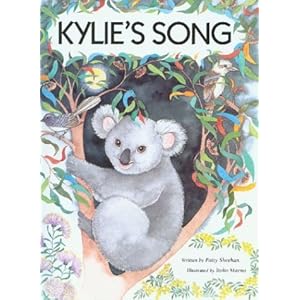
I happened upon a book titled “Kylie’s Song” written by Patty Sheehan. Patty Sheehan has a background in both teaching and counseling. It was published by Advocacy Press, a publishing group that supports and develops equity oriented publications for young children, adolescents and young adults. This book could be appropriate for children of all ages. The story is simple and relatable. It takes place in Australia. A young koala bear named Kylie is naturally inclined to sing. The dilemma is that Koalas do not sing, so she is ridiculed by her peers. At first, she ignores the comments made by others. Eventually, the harassment gets so bad that she runs away and cries. Her mother tries to comfort her and recommends that although she enjoys singing perhaps she should never sing again in order to fit in with the other koalas and avoid conflict. The mother koala admits that she too yearns to sing, but holds back in order to avoid ridicule. So, Kylie stops singing, however her mother notices a change in her behavior and emotional state. Kylie just isn’t the same, more solemn. So, as Kylie reaches the age of maturity and moves on to her own tree, her mother decides to support Kylie’s passion for singing. She tells Kylie to find a tree where she can sing because she wants her to do the thing she loves. So Kylie heads off and finds a place where a platypus plays the drums and a wallaby dances. She joins the band of misfits and pursues her passion. She takes singing lessons from a bird and becomes a celebrated singer in the community. Even those that made fun of her before praised her singing and learned to accept her differences. In the end she becomes a role model for other koalas that want to sing, including her mom.

In this book, after the end of the story there is a brief description of multiple intelligences. It concludes with ways adults can support young creative minds. There is also a list of great discussion questions already included, like “What did mama koala learn from Kylie at the end of the story?” The discussion could diverge away from the book into the lives of the students. Students could team up and discuss ways stereotypes influence behavior. Students could write downs their dreams, no matter how impossible they may seem and draw a picture or make a collage to go with it. Students too young or unable to write about their desires could draw a picture of what they want to be when they grow up. Different activities could be set up to challenge gender stereotypes, such as girls playing football and boys cheering on the sidelines. This story could also be used as a tool to gain insight on a student’s interests or talents.
-McQ, Art

M.V.'s Book Selection


Leo the Late Bloomer is written by Robert Kraus and illustrated by Jose Aruego. This is a great book for prek-1st grade. The main character is Leo who is behind in reading, writing, drawing, eating neatly and speaking. Leo’s father becomes concerned, but Leo’s mother knows that Leo is simply a late bloomer. Sure enough in Leos own time; he blossoms and is able to do what his friends can do.

The theme for my lesson would be family relationships, growing up, and Self-Esteem. When reading the book, I would stop and ask questions such as how do they think Leo felt about not being able to do the things his friends could do? Questioning them will create discussion about skills they would like to master. Students will create a list of the skills and abilities they are most proud of. They can create illustrations to go with their chart. This book will be great to show that it is ok that not everyone is at the same level, especially in prek- kinder, where students are still developing. They need to realize that they too have strengths and with practice and time they will be able develop more skills.
mv


S.S.'s Book Selection

The story I chose for my book review is The Adventures of ERIK, a biography by Gloria Jasperse. The book is designed for an above-level second grade reader. The story of Erik Weihenmayer captivates the students interest through his many adventures. Erik is a man who loves challenges. His whole life has been filled with many adventures normal people would never experience. For example, in the book Erik jumps from airplanes, scuba dives in deep waters, and climbs to the top of mountains. What makes Erik's life story even more interesting is he accomplishes these adventures all while being blind. Erik Weihenmayer first caught my attention while watching a reality TV show called The Amazing Adventure. Each team was to complete challenging obstacles throughout many different countries to reach the finish. Although Erik could not see, he was able to complete each leg of the race with the help of his teammates. Many of the other players with great eye sight could not accomplish what Erik had accomplished blind.

The book was given to my above-level readers to accomplish on their own. After they read the book, they would discuss it with me during our small group sessions. Before we could begin our group session, I had students asking me questions about Erik. They were so excited to learn more about a man who has not let his handicap stop him from the joys of life. Instead of small group time, we used this opportunity to research Mr. Weihenmayer. Erik Weihenmayer's life is able to show students that anything is possible in life.


M.Er.'s Book Selection

Mary Hoffman's story Amazing Grace would be a good book to read with kindergarten through third grade students. The books' main character is Grace, a girl who loves to become the main character of the stories that he reads or hears. When her class is putting on the play Peter Pan, Grace wants to play the part of Peter, but students in her class tell her she can't because she is black and she's a girl. At home, her mom and grandma tell her she can do anything she wants. Her grandma takes her to the ballet to see a young black dancer play the part of Juliet in Romeo and Juliet. When Grace tries out for the part of Peter, everyone thinks she is perfect. I think this would be an excellent story to explore with my students to show the creativity that Grace expressed when she took on the characters of different stories and acted them out as well as how she overcame adversity of others telling her she couldn't do something.

We could discuss books students have read that they would enjoy acting out. We would focus on what Grace was told she couldn't do (that she couldn't be Peter Pan) and why (because she was a girl and she was black). We would talk about what it means when someone tells you that you can't do something and discuss the difference between "you can't do it because you're a girl/black/etc" and "you shouldn't do it because it will hurt you." I would ask my students if they had ever been told they couldn't do something for some reason. Students would be encouraged to share their experiences and what they did - did they give up and not try or did they try anyway. Students will be asked to choose their favorite book or story and find a way to tell that story to the class. They can act it out, draw a picture; they can share the story in any way they choose.
ME.
 

T.W.D.'s Book Selection

Walter the Farting Dog is a children’s book written by William Kotzwinkle and Glenn Murray. It was on the New York Times bestseller list, with over one million copies sold. The intended audience of the book could range from infants to the elderly, anyone who relishes in the offbeat humor of flatulence. I chose this book because all of my students love to laugh about “gas.” To summarize Walter the Farting Dog, we start with a pound mutt who is adopted by a family who is unaware of his problem. They bathe him, change his diet, and ultimately warn him to stop “gassing” or he will be sent back to the pound. While Walter is wallowing in self-pity, his house becomes burglarized and Walter saves the day by “letting go” of the most awful fart known the man. Thus, leading Walter to become a hero to his family and keeping his new home.

There are several ways to incorporate Walter’s gas in the Science curriculum. You could ask about the different types of solids, liquids, gases and where Walter’s flatulence is categorized. There are numerous vocabulary opportunities throughout the story along with figurative language. I could have the students change the main character of Walter to a female animal, and develop ideas of how a female would be treated verses a male. We could change the ending to Walter not becoming the hero, but becoming an accomplice to the burglars and runs-off to a life of crime. We could play “top that” with guiding questions about Walter and his transformation from becoming an unwanted dog to a family hero. TWD/SPED

Mr. Del Toro's Book Selection

"Miss Nelson is Missing!" by Harry Allard fits in with this week's theme, being that it is National Teacher Appreciation Week. In Pk-C, I, Mr. Del Toro, I chose to read this book at the beginning of the school year, coming back from the long breaks, and now that we get close to the end of the school year because it is when discipline issues mainly occur. This is a great way to make students conscious about their behaviors and how they would imagine to be affected, even though Viola Swamp obviously won't show up. This book is about a class that misbehaves during reading and other lessons, they disrespect the teacher and act up all the time. The teacher decides to dress up as a mean substitute teacher by the name of Viola Swamp, and is very hard on them leaving them tons of homework and classwork. She is very strict and omits recess and fun activities. By the time Miss Nelson comes back they are well behaved because they missed her while she was "missing".

The students may write about what experiences they have been through to maybe make a teacher upset or identify discipline problems that they have caused in the past. They later can predict how it would be different if they had a more strict teacher or a substitute that does not tolerate bad behavior. Furthermore the students can act out this story in a play as an extension activity. I would foster discussion among the students by asking what Miss Nelson could have done differently to control her class in lieu of dressing up as Viola Swamp and also ask how this would have changed the ending to the story?
Finally, as an extension, at a PTA night the students can do a play for the parents with both versions, their own version and the original version.
---Thank you, Mr. Del Toro, Pk-C Teacher, Lida Hooe Elem.

L. Peltz's Book Selection

The Story of the Thousand Paper Cranes by Eleanor Coerr

This story is about a young Japanese girl named Sadoko Sasako. When she was 2 years old, the atomic bomb was dropped on Hiroshima near her home. When she was 12 years old, she was diagnosed with leukemia (the Atom Bomb disease). While in the Hiroshima Red Cross Hospital, she started to try to make 1000 origami cranes. It is a Japanese legend that if you make 1000 cranes you will be granted your wish. She died at the age of 12 but her classmates raised money to have a statue made in her honor in Hiroshima Peace Park.

There are many versions of this story. If you cannot find a book then just do a web search to find information. Some say she only completed 644 and others say she did make 1000 cranes. It doesn’t matter which you believe because the point is that she wished for world peace and for no kids die from war.

Extension 3rd-th grade activities: More research on WWII, making 1000 origami cranes and hanging them in hallway, retelling story on PhotoStory or MovieMaker, celebrated this during Asian Month.

http://en.wikipedia.org/wiki/Sadako_Sasaki
http://en.wikipedia.org/wiki/Sadako_and_the_Thousand_Paper_Cranes

B. McAfee's Book Selection

There is a short book by Mary Reid called Beatrix Potter. It is an easy to read version of the English illustrator's biography. In 10 pages, the reader gets a glimpse of Potters' gifted attributes. Since childhood, she drew things that she saw in nature. her illustrations were so detailed that were used in research papers. But her talent was not only drawing. She also had the ability to create engaging stories about the animals she drew. She had an unusual interest in all kinds of animals and their way of life. With the money from her books, she bought land and created a National Park in England.

Almost every child enjoys drawing. After reading this book, the students might want to research more about an animal of their interest, to create their own story. Other students might be interested in learning more about Potter's life and illustrations. They might be even interested in learning about Potter's estate in England. To foster students' discussions, the teacher might ask why children enjoy so much Potter's books, or why do they think she bought so much land in England. As an extension, the students might choose one of Potter's characters and create their own story. They can also write an essay about the projects they would finance or build if they were recognized authors or illustrators and who would benefit from them.
B. McAfee


K. Merriott's Book Selection


 K. Merriott said...
“Martin’s Big Words” is a beautifully written and illustrated book about the life of one of history’s greatest leaders and speakers, Dr. Martin Luther King, Jr. The author of the book is Doreen Rappaport and the illustrator is Bryan Collier. This book won the Best Illustrated Children’s Book award by the New York Times in 2001. This particular book also lends itself well to a K-3 audience because the words are simple and easy to understand. I chose to review this book because it tells the story of a gifted leader and speaker who taught people to fight back with nonviolence instead of violence. It tells the story of how Dr. King suffered from segregation in the Deep South, and eventually grew into a key player in ending racial segregation. For ten years, Martin led nonviolent protests in order to end segregation. People threatened to kill him and his family. His house was bombed, and his brother’s house was bombed. He still refused to stop fighting for what he believed in. His hard work paid off when The Civil Rights Act was finally passed on July 2, 1964. Sadly, nearly four years later, Dr. King was assassinated in April 1968. Our society, however, still reaps the fruits of his words and works even today.

All too often, we look forward to certain holidays as being a vacation day without knowing the significance of the holiday. Martin Luther King Day is one of those holidays whose significance should be discussed with our students. After reading “Martin’s Big Words”, ask students to try to imagine what our society would be like today if Dr. King had not fought for desegregation. Engage students in accountable talk by posing such questions as, “Do you think that there would still be segregation amongst blacks and whites?”, “Do you think that segregation now would affect other races besides blacks and whites?”, “How would our personal lives possibly be different if segregation still existed?” You could also ask students questions such as, “Have you ever been treated differently or been left out because you were different from others?”, “How did it make you feel?”, “What supposedly made you different from others?” Point out to students that skin color is not the only thing that can segregate people. Ask students if they can think of other factors that can lead to segregation. Examples could include age or social status. Students could also create a timeline of Dr. King’s life as a great extension activity.